
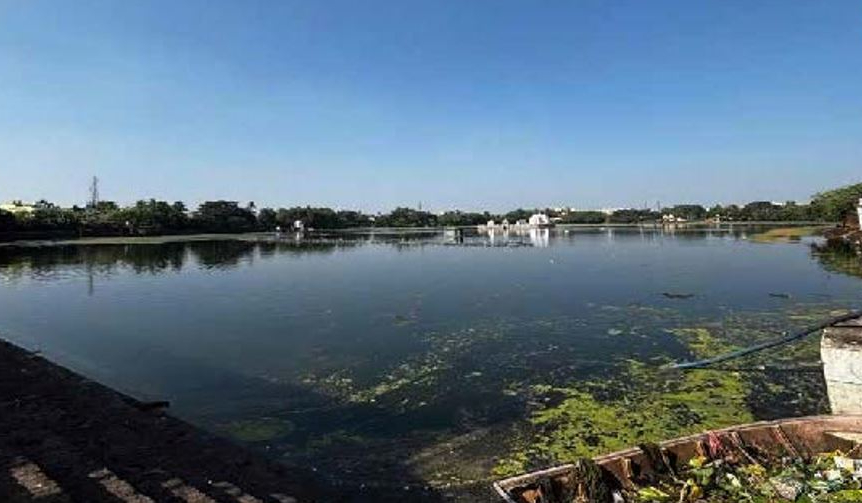

Sacred Waters: Bindusagar Tank & Lake
My City Links presents a new series on city tales extracted from the book ‘Sacred Waters’ by Anisha Swain under the guidance of Anil Dhir, Convener, Bhubaneswar Chapter at Indian National Trust for Art and Cultural Heritage (INTACH). In this series, we will be featuring some of the Temple tanks of Ekamra Kshetra.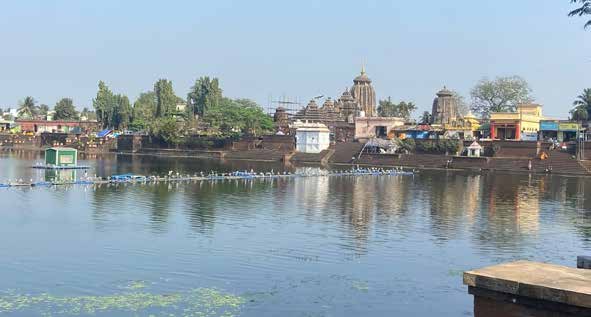
Temple tanks, revered as sacred water bodies, have played a crucial role in religious and cultural traditions across India. In Odisha, these tanks, known as Kundas or Pushkarinis, are deeply linked to Hindu rituals, mythology, and community life. Historically, they were commissioned by kings and nobles as acts of spiritual merit and served as essential water sources. Rooted in Vedic traditions, these tanks are associated with Varuna, the water god, and believed to possess purifying qualities.
Bhubaneswar, the "Temple City," is home to many such sacred tanks, including Marichi Kunda, Kotitirtha, and Swetaganga, each carrying unique mythological significance. Pilgrims still bathe in these waters before visiting temples, maintaining age-old traditions. Beyond their spiritual role, temple tanks contribute to the ecological balance of urban landscapes, acting as natural reservoirs that sustain groundwater levels.
However, rapid urbanization threatens their existence. Encroachments and neglect have left many tanks dependent solely on rainfall, making maintenance crucial. Preserving these water bodies is not just about cultural heritage but also about sustainable water management. In a time of global water crisis, revisiting these ancient traditions can inspire a more respectful and sustainable approach to water conservation. This time let’s have an overview of the Bindusagar Tank & Lake in detail.
Bindusagar Tank & Lake
Historic significance: Bindusagar Lake, dating back to the 7th or 8th century A.D., is the largest water body in Bhubaneswar and is deeply connected with the rituals of the Lingaraja Temple. According to local legend, Shiva and Parvati, after their marriage, initially lived in Varanasi (Kashi). Over time, as Varanasi grew more populated, Shiva chose to move to Ekamrakshetra (modern-day Bhubaneswar) to meditate secretly, hence earning it the name Gupta-Kashi, or “Hidden Varanasi.” This area, once covered in jungle, was home to a massive mango tree standing alone amidst the wilderness.
Parvati, with the help from Brahma, discovered Shiva’s location by observing cows flocking to the mango tree and instinctively releasing milk at a particular spot beneath the tree. Recognizing her husband’s presence, she took on the role of a milkmaid to care for the cattle. The path taken by the cows came to be known as Gosagaresvar. During this time, two demons, Kirti and Vasa, became enamored with Parvati and made advances toward her. In her fury, Parvati pressed them into the ground with her feet, creating a place now called Devi Padahara. After the battle, Parvati rested at a site that became the Bhabani Shankar Temple. Thirsty from her ordeal, she asked Shiva for water, and he struck his trident into the ground, summoning a spring that became Bindusagar Lake. This sacred lake, filled with water sanctified by all rivers, is now an integral part of Bhubaneswar’s sacred landscape.
Cultural significance: Kartikapurnima, Chandana Yatra, and the ritual bath of the deity and devotees. It is considered one of the Panchatirthas, and is deeply connected with the rituals of the Lingaraja Temple. There is a Jagati (island) temple at the center of the lake which was used during the Chandan Yatra ritual.
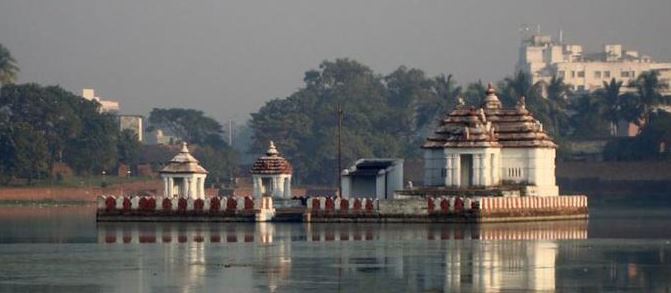
Physical Description: It is surrounded by embankments on all four sides, bordered by several significant temples. The Ananta Vasudeva Temple lies across the road on the eastern embankment, while the Mohini Temple is situated 13 meters to the south. On the southeastern side, the Markandesvara Temple stands within 20 meters of the lake, and the Uttaresvara Temple precinct is located along the northern embankments. Each embankment of the lake is equipped with bathing ghats, featuring steps made from large, durable laterite blocks, offering a structured approach for devotees and visitors engaging in ritual baths and lake-related activities.
Architectural features:
● Plan and Elevation: Almost a rectangular plan measuring 450 m in length, 175 m in
width, and 5m maximum in depth.
● Building Material: Dressed Laterite blocks
● Construction Techniques: Dry Masonry
Bindusagar Lake is encircled by a rich array of shrines and temples on all four embankments, each hosting a unique set of deities:
● Eastern Embankment: Here, shrines include Dwarabasini, Ananta Vasudeva, Brahma,
and Hanuman.
● Western Embankment: This side features the Lingaraja Rest House, Nilakanthesvara,
Akhadachandi, Paschimesvara, and the Markandesvara Temple.
● Northern Embankment: The northern side hosts the Uttaresvara Temple precinct and
Emara Matha.
● Southern Embankment: Key shrines here include Swarnadhiswara Bhabanisankar, Sari
Deula, Mohini Temple, and Akhandalamani (also known as Panchanana).
Special Features: Bindusagar Lake, historically fed by a natural underground spring, has a unique system for maintaining a steady water level. Excess and waste water exit through an outlet channel located in the southeastern wall, running beneath Talabazar Road near Dalmiya Dharmasala. This channel, with dimensions of approximately 1.18 meters in height and 1.07 meters in width, helps maintain a constant water level year-round. However, despite these ancient provisions for freshness and cleanliness, Bindusagar Lake has become polluted. This deterioration highlights an urgent need for targeted restoration efforts to return the lake to its pristine condition.
Maintained By: Lingaraj Temple Administration
Ownership: Public
Current State: Perennial; Contaminated; Requires Intervention