
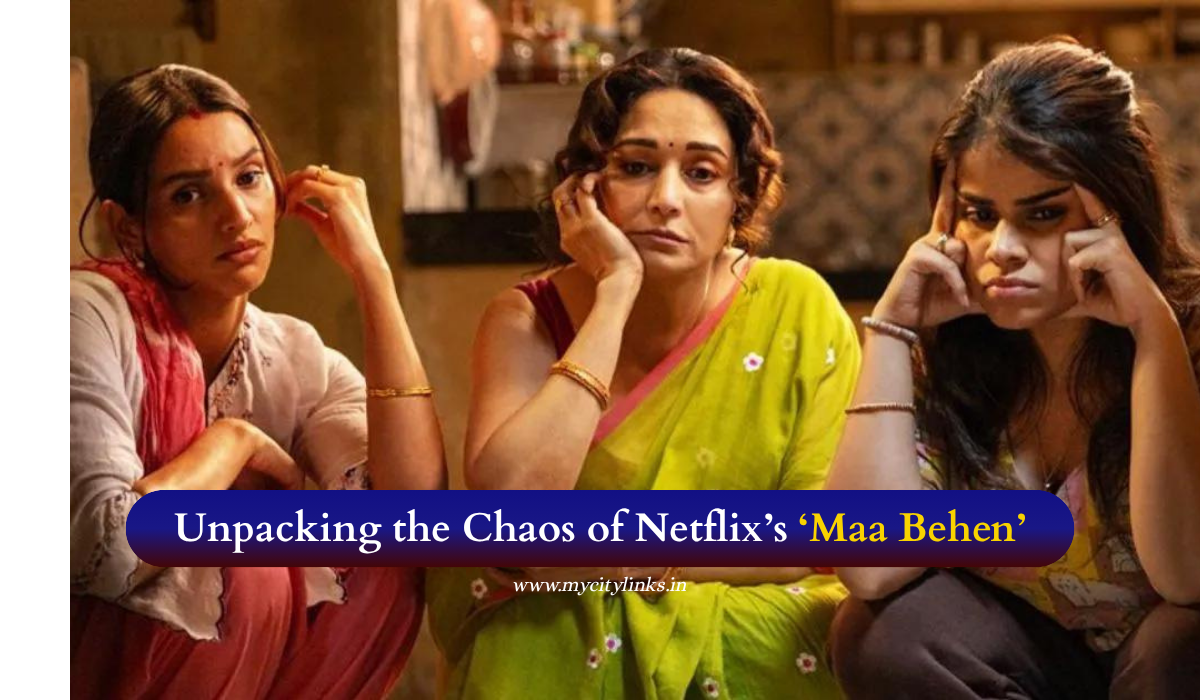

Unpacking the Chaos of Netflix’s ‘Maa Behen’
Hindi cinema has a long history of using words like ‘maa’ and ‘behen’ as the foundation for its loudest, angriest swear words. But Suresh Triveni’s new Netflix release, ‘Maa Behen’, flips that script entirely. Instead of handing its female leads a heavy, predictable revenge plot filled with screaming monologues, the film dives headfirst into absolute chaos. It’s a pitch-black comedy that forces us to laugh at the ridiculousness of everyday Indian patriarchy, while quietly making us realize that the joke might actually be on us.

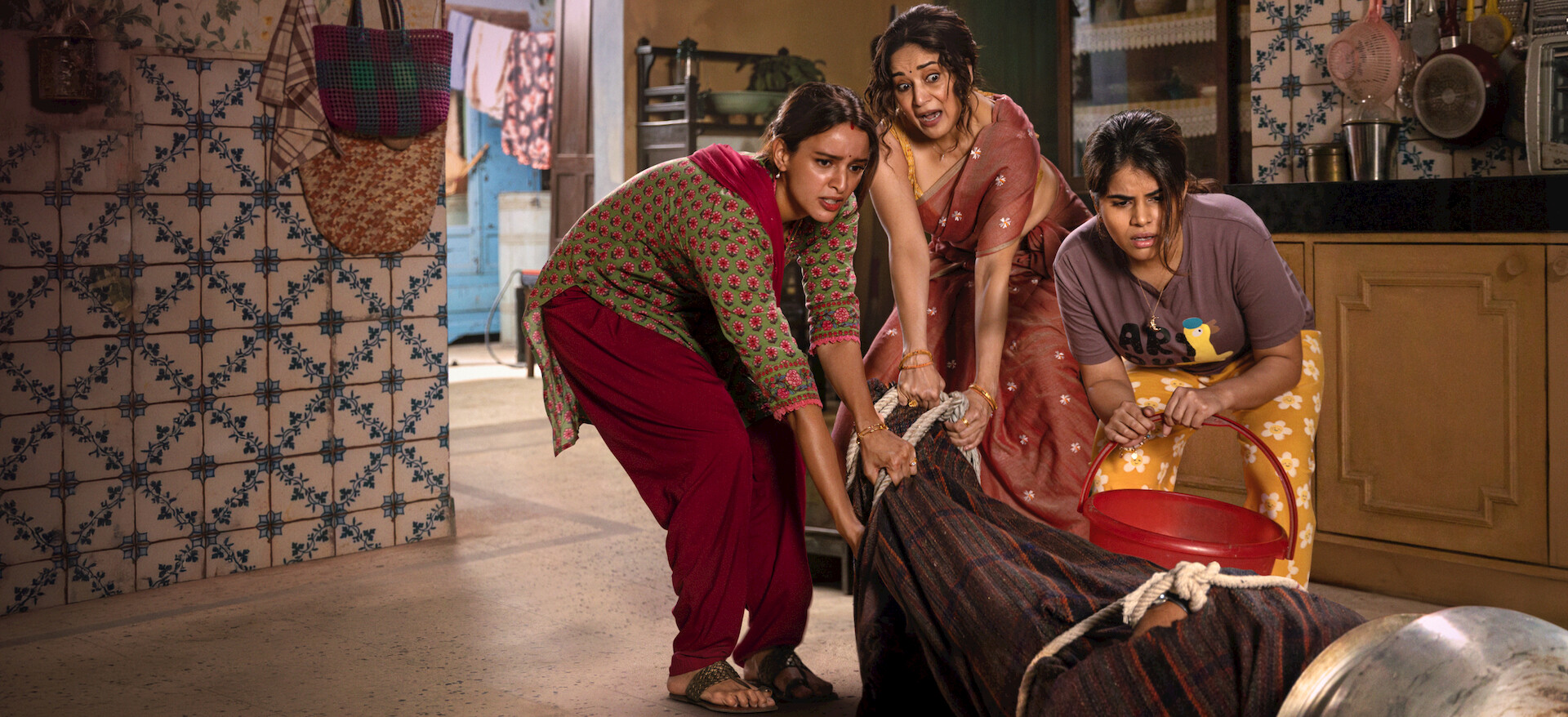
The narrative kicks off with an absurdly dark premise in the claustrophobic, hyper-judgmental ecosystem of a middle-class residential neighborhood. Rekha (played with infectious, radiant joy by Madhuri Dixit Nene), a glamorous single mother and widow, makes a panicked late-night phone call to her two estranged daughters. The emergency? She has just found the dead body of her notoriously nosy neighbor, Guptaji (Ravi Kishan), sprawled across her kitchen floor.
What follows is an unhinged, race-against-the-clock cover-up. Jaya (Triptii Dimri), the older daughter, arrives weary from her own suffocating domestic life, where she has literally kept count of the thousands of ‘rotis’ she has rolled for her in-laws. Sushma (Dharna Durgaa), the younger sibling, is an aspiring content creator obsessed with internet clout and virality.
To avoid the immediate social execution that comes with being an independent woman associated with a male corpse, this fragmented trio must band together to hide the body from a colony where no secret is ever safe.
‘Maa Behen’ has all the ingredients of a heavy-handed social drama. A single mother constantly policed by her neighbors; a daughter trapped in a patriarchal marriage; and a young woman navigating the toxic underbelly of social media validation. Yet, the film’s greatest strength is its absolute refusal to indulge in a pity party.
Triveni and co-writer Pooja Tolani directly challenge the deeply ingrained bias that demands a woman must be a ‘bechari’ (helpless victim) to earn the audience's empathy. Rekha, Jaya, and Sushma (names used in the famous Nirma soap jingle) are flawed, messy, and loud. Even in the middle of a literal crime cover-up, they argue over minor grievances, fret over eating eggs on a Monday, and make incredibly questionable choices.
By allowing these women to choose humor, beauty, and joy in the face of absolute disaster, the screenplay delivers a sharp rebuke to internalized patriarchy. It takes direct aim at the social conditioning that dictates how women should behave when they are under scrutiny. The neighborhood walls are literally scrawled with lewd graffiti shaming Rekha’s autonomy, yet the film's response is a liberating, collective shoulder shrug: why care?
The brilliance of ‘Maa Behen’ lies in how its structure deliberately exposes the viewer’s personal biases. The film utilizes a brilliant narrative device: a sensationalist crime-show host (evoking the classic “Chain se sona hai toh jaag jao” trope) who breaks the fourth wall to recount past events and rumors.
As the screenplay unravels multiple conflicting versions of how Guptaji ended up dead, it holds up a mirror to the audience. We realize how quickly we, as viewers, are willing to fill in the blanks with cynical assumptions based on how a character looks or lives. The writing subtly forces us to question why society, and by extension, the audience, is fundamentally uncomfortable with a household of women thriving entirely without a male anchor.

While the film loses a bit of its narrative momentum in the mid-second half due to a few repetitive loops, the electric, unhinged chemistry between Madhuri, Triptii, and Dharna keeps the emotional core entirely intact. The banter feels less like a polished script and more like the unfiltered, raw chaos of a real family crisis.
‘Maa Behen’ doesn't arrive waving a feminism handbook or lecturing its audience. It simply constructs a world where women are allowed to be deeply human rather than symbols of virtue or victimhood, and that makes it one of the sharpest, most refreshing satires of the year.
The Verdict: Maa Behen is a wild, organic, and beautifully irreverent dark comedy that sneaks up on you with profound social commentary. Come for the stellar performances; stay for the sharp dismantling of the biases we carry every day.